Capital Gains Tax Rules: Are They Changing?
Christine MacPherson • January 30, 2025

With all the uncertainty surrounding Canada’s proposed capital gains tax changes, many property owners are asking, "Do I have to pay capital gains if I sell my house?" or "Should I sell my investment property before the tax rules change?"

In June 2024, the federal government proposed increasing the capital gains inclusion rate—the portion of capital gains that is taxable. This change could significantly impact investors and property owners selling secondary residences, rental properties, or cottages.

But here’s the challenge: the rules haven’t been finalized yet. As Jamie Golombek explains in a recent Financial Post article, Uncertainty remains as to what the final capital gains tax rules will look like, or even if they will be implemented at all.

Despite this uncertainty, the Canada Revenue Agency (CRA) has announced it will proceed with collecting taxes based on the proposed higher inclusion rate until a final decision is made. This means that even if you sell now, you could still face a larger tax bill. If the rules are later changed or rejected, the CRA may adjust tax filings—but in the meantime, selling could cost you more than you expect.

The good news? Selling isn’t your only option. If you need access to cash or want to better manage your finances, refinancing or exploring alternative lending solutions could provide the flexibility you need—without triggering a large tax bill.


Ways to Access Cash Without Immediately Selling

If you need funds but aren’t sure whether selling is the best choice, here are some flexible ways to access cash while holding onto your property:


1. Refinancing Your Mortgage

  • Access tax-free cash by using your home equity.
  • Adjust your mortgage terms to fit your financial needs.
  • Keep your property and continue building long-term wealth.


2. Alternative and Private Lenders

  • Flexible lending options with easier qualification.
  • Quick access to funds without selling your property.
  • Short-term solutions to manage cash flow.


3. Reverse Mortgage (For Canadians 55+)

  • Access tax-free equity with no monthly payments.
  • Stay in your home while improving cash flow.
  • Ideal for retirees on fixed incomes.


4. No-Payment Loan Options

  • Interest-only or deferred payment loans.
  • Manage expenses without immediate financial pressure.
  • A flexible option to bridge financial gaps.


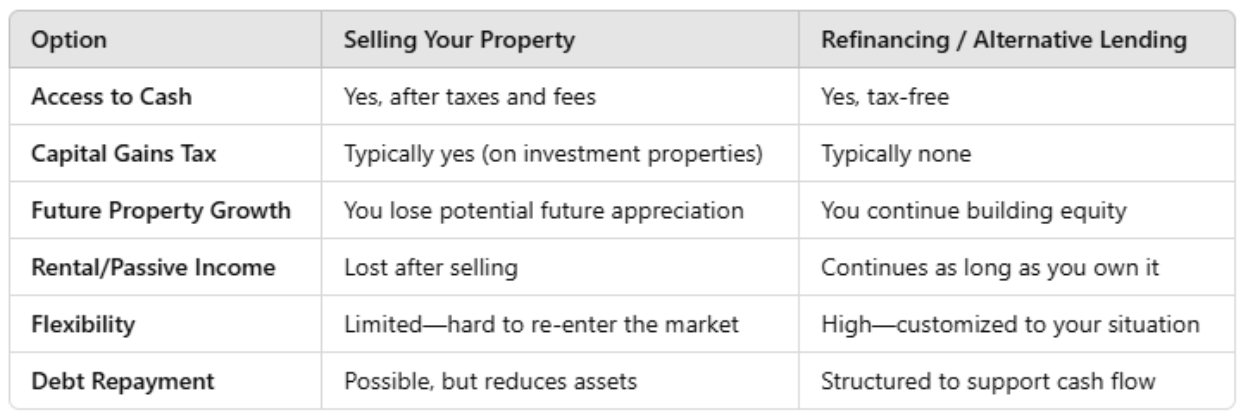
Comparing Your Options: Sell or Keep Your Property?

It’s important to weigh the pros and cons before making a decision.


Here’s a simple comparison of selling versus other financing strategies:
Let’s Build a Strategy That Fits Your Goals

Whether refinancing, working with private lenders, or considering a reverse mortgage, understanding every option is essential. I work closely with your accountant to create a strategy that helps you minimize taxes and achieve both your short- and long-term financial goals.

I offer a clear, side-by-side comparison of all your financing options so you can make the best decision for your financial future.


📞 Call me at 403-968-2784
📧
Email me at christine@flaremortgagegroup.com


Know someone else who’s unsure about what to do? Share this post—many Canadians don’t realize they have options beyond selling.

Let’s talk about what works best for you.

SHARE THIS ARTICLE

RECENT POSTS


By Christine MacPherson February 23, 2026
The biggest question I am getting right now from buyers in Edmonton and area is simple. Should I lock in my rate or go variable in 2026? With rate changes over the past two years and renewed speculation about what the Bank of Canada will do next, choosing between fixed and variable is no longer a simple decision. The right strategy depends on your goals, risk tolerance, and timeline. Let me break it down clearly so you can decide what makes sense for you. Where Mortgage Rates Stand in 2026 After a volatile cycle of increases followed by gradual easing, 2026 has introduced more stability into the mortgage market. Fixed rates have adjusted downward from peak levels, while variable rates have started to look competitive again as expectations grow around future Bank of Canada rate cuts. Here is the key difference: Fixed rate mortgage: Your interest rate stays the same for your full term. Your payments stay predictable. Variable rate mortgage: Your rate moves with the prime rate. Payments or interest portion may change depending on your lender structure. Buyers in Edmonton are asking whether stability is worth paying slightly more today, or if flexibility and potential savings are worth some short term uncertainty. When Locking In Makes Sense in 2026 There are situations where a fixed rate mortgage is the smarter move. You Want Payment Stability If you are buying your first home or stretching your budget, stability matters. A fixed rate protects you from surprises and allows you to plan with confidence. You Believe Rates Could Rise Again While forecasts suggest moderate easing, inflation and global economic uncertainty still exist. If rates rise unexpectedly, fixed rate borrowers are protected. You Prefer Peace of Mind Some buyers simply sleep better knowing their payment will not change. There is real value in that. For families purchasing in Edmonton, especially those managing childcare costs or other major expenses, predictability often outweighs potential savings. When Variable Could Be the Better Strategy Variable rates are making a comeback in 2026. Here is why they are worth considering. You Expect Further Rate Cuts If the Bank of Canada continues to reduce rates later this year, variable mortgage holders benefit immediately. You Plan to Sell or Refinance Variable mortgages often have lower penalties if you break your term early. If you plan to move, refinance, or restructure in a few years, this flexibility can save thousands. You Have Financial Cushion If your budget allows room for payment fluctuations, variable can be a strategic way to reduce long term interest costs. Historically, variable rates have often outperformed fixed over the full term. The key is whether you are comfortable riding out short term volatility. Comparing Fixed and Variable in 2026 Here is a simplified comparison to help buyers in Edmonton understand the trade offs. Fixed Rate Payment Stability: High Rate Movement: None during term Penalty to Break: Higher Best For: Risk averse buyers Potential Savings: Stable but limited Variable Rate Payment Stability: Moderate Rate Movement: Moves with prime Penalty to Break: Often lower Best For: Flexible buyers Potential Savings: Greater if rates fall A Smart Strategy for Today's Buyers There is no universal answer. The best mortgage strategy in 2026 depends on three things. Your financial comfort level Your timeline in the property Your long term plans Some buyers are even choosing shorter fixed terms, such as three years, to balance stability and flexibility. Others are exploring adjustable variable options with capped payments. As your mortgage professional in Edmonton, my role is to walk you through real numbers, not headlines. We run payment scenarios under different rate environments so you can see exactly what risk and reward look like. What First Time Buyers Should Consider If you are entering the market for the first time, qualifying is already stressful. In many cases, locking in can simplify your transition into homeownership. If you are upgrading and have equity, you may have more room to take a calculated risk with variable. Every Buyer's Situation is Unique Rates are no longer at emergency lows, but they are also not at peak highs. That creates opportunity. The question is not whether fixed or variable is better in general. The question is which one fits your life right now. If you are buying in Alberta, let's build a strategy that protects your budget and positions you for long term success.  Call 403-968-2784 or email christine@flaremortgagegroup.com to review your options. I would be happy to walk you through the numbers and help you make a confident decision.
By Christine MacPherson December 15, 2025
Why International Tensions Could Shift Real Estate Opportunities at Home
Show More