Bank of Canada Cuts Rates by 50 Basis Points: What It Means for Your Mortgage

Christine MacPherson • December 16, 2024

The Bank of Canada recently made headlines by cutting its benchmark interest rate by 50 basis points, a move aimed at providing relief to borrowers and stimulating economic growth. This rate cut—the second in recent months—is a game-changer for homeowners and prospective buyers alike. As your trusted mortgage broker, we’re here to break down what this means for you and how it could impact your financial decisions.
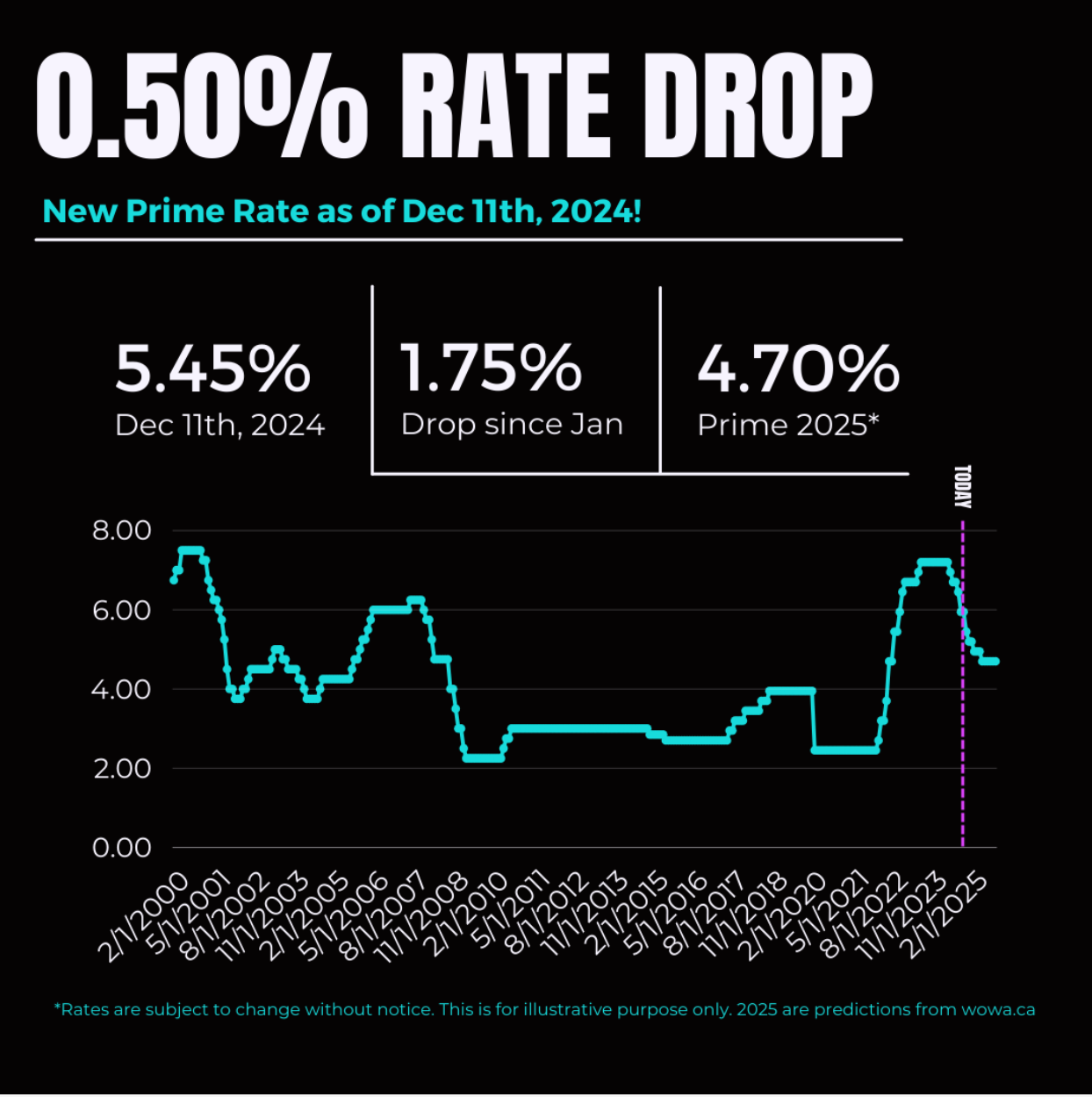
Key Highlights of the Rate Cut

  1. Lower Borrowing Costs: The rate cut reduces borrowing costs for variable-rate mortgage holders and those seeking new financing. Adjustable-rate mortgage holders will see immediate savings, while prospective buyers can benefit from more affordable loans.
  2. Refinancing Opportunities: For homeowners with fixed-rate mortgages approaching renewal, this may be the perfect time to refinance and lock in a lower rate, potentially saving thousands.
  3. Boosted Buyer Activity: Lower rates could fuel increased activity in the housing market, creating opportunities for both buyers and sellers.


What This Means for You

For Current Mortgage Holders: If you hold a variable-rate mortgage, you’re likely to see a reduction in your monthly payments. This is a great time to explore options like consolidating debt, funding home improvements, or upgrading to a larger property.

For First-Time Buyers: Reduced rates make homeownership more attainable by increasing affordability and borrowing capacity.

For Real Estate Investors: Lower borrowing costs enhance profitability, making this an opportune moment to expand your portfolio or diversify your investments.


How I Can Help

Navigating market shifts can be complex, but I’m here to simplify the process and provide tailored solutions to meet your needs. Here’s what I can offer:

  1. Mortgage Reviews: I’ll analyze your current mortgage to identify savings opportunities and help you make informed decisions.
  2. Pre-Approvals: Secure a pre-approval to understand your budget before entering the housing market and lock in a rate for up to 120 days.
  3. Customized Advice: From first-time buyers to seasoned investors, I can provide guidance to ensure you maximize your benefits under the new rate conditions.


Why Stay Informed?

Understanding market trends is key to making smart financial decisions. This rate cut is an opportunity to reassess your mortgage strategy, whether you’re planning to buy, sell, or refinance. I encourage you to reach out for a no-obligation consultation to explore how these changes could benefit you.


Don’t let market changes pass you by. Whether you’re looking for advice on your current mortgage or exploring new opportunities, we’re here to help. Contact us to schedule a consultation and take the first step toward achieving your financial goals.


📞 403-968-2784
📧
christine@flaremortgagegroup.com

🌐 Visit: www.mortgagesbychristinem.ca

SHARE THIS ARTICLE

RECENT POSTS


By Christine MacPherson April 6, 2026
When most people think about mortgage rates in Canada, they think about inflation here at home, jobs here at home, and Bank of Canada announcements. Those things absolutely matter. But global events matter too, and right now they matter a lot. On March 18, 2026, the Bank of Canada held its policy rate at 2.25 percent and made it clear that the war in the Middle East has increased volatility in energy prices and financial markets, while raising risks for the global economy. Global News also reported that policymakers are watching the conflict closely because higher oil, transportation and fertilizer costs could spill into inflation and affordability pressures for Canadians. This matters if you are buying, refinancing, renewing, or simply trying to decide whether to lock in a rate. In my view, the real story is not just that Canada held rates steady. The bigger story is that global pressure can quickly change where mortgage rates go next, even when nothing dramatic has changed in your own neighbourhood. Why a war far from Canada can affect your mortgage Canada does not set mortgage rates in a bubble. The Bank of Canada said the conflict has driven sharp increases in global oil and natural gas prices, and that it could also disrupt the movement of other commodities, including fertilizer, through transportation bottlenecks linked to the Strait of Hormuz. Governor Tiff Macklem added that while Canada is not hit directly in the same way as some regions, reduced global supply still means higher global prices. That is the kind of pressure that can make inflation harder to control. When inflation risks rise, central banks get cautious. That does not always mean an immediate rate hike, but it can mean fewer cuts, longer holds, or tougher language. That is exactly why this latest Bank of Canada announcement matters. The Bank held, but it also signaled that the outlook is more uncertain and that it is prepared to respond as conditions evolve. What this means for variable mortgage rates If you have a variable rate mortgage, the Bank of Canada is still the main thing to watch. Variable rates in Canada are closely tied to lender prime rates, and prime typically moves when the Bank changes its overnight rate. As of March 27, 2026, Canada’s prime rate is 4.45 percent, and Ratehub notes that variable mortgage rates have remained stable following last week’s rate hold. So, for now, borrowers with variable rates have not seen a fresh jump just because of the war. But the risk has changed. If global conflict keeps energy prices elevated and inflation proves harder to cool, future cuts may be delayed. In plain English, this means some borrowers who were hoping for lower payments later this year may need to prepare for a longer period of higher borrowing costs than expected. That is not a certainty, but it is a reasonable takeaway from the Bank’s current tone. Variable rate borrowers should focus on payment room If you are in a variable rate mortgage right now, this is a good time to review your budget honestly. Ask yourself whether your payment still feels comfortable if rates stay where they are for longer. A lot of borrowers were planning around future relief. The new global backdrop is a reminder that relief can get delayed very quickly. What this means for fixed mortgage rates Fixed rates are a little different. They are not priced directly off the Bank of Canada’s overnight rate. TD explains that fixed mortgage rates are based on the bond market, with Government of Canada bond yields used as a benchmark. Ratehub now says the ongoing conflict in the Middle East and the shrinking likelihood of central bank cuts are pushing bond yields higher, and that fixed mortgage rates increased significantly this week. That distinction is important. Even if the Bank of Canada does nothing at its next meeting, fixed rates can still move. If investors keep pricing in higher inflation risk, lenders can raise fixed mortgage pricing before the Bank ever changes its policy rate. For buyers and renewing homeowners in Edmonton, that means waiting can carry a real cost. What buyers and homeowners in Edmonton should do now I think this is a planning market, not a panic market. The latest data does not say every borrower should rush into the same product. It does say that global events are now part of the mortgage conversation again, and ignoring them is a mistake. If you are buying, get pre approved and secure a rate hold while you shop. Ratehub notes that current pricing can often be held for up to 120 days, which can be valuable in a market where fixed rates are moving. If you are renewing, compare your options early instead of waiting for the lender’s first offer. If you are refinancing, think beyond rate alone and look at cash flow, penalty costs, and how much payment certainty matters to you right now.  The bottom line The Bank of Canada did not raise rates in March. But the global pressure behind mortgage rates is clearly building. War driven energy shocks can feed inflation. Inflation pressure can keep central banks cautious. Cautious central banks and rising bond yields can keep mortgage costs higher for longer. That is the chain Canadians need to understand right now. If you want to talk through your options in Edmonton, I am happy to help you compare fixed and variable strategies based on your timeline, budget, and risk comfort. Call 403-968-2784 or email christine@flaremortgagegroup.com to start the conversation.
By Christine MacPherson February 23, 2026
The biggest question I am getting right now from buyers in Edmonton and area is simple. Should I lock in my rate or go variable in 2026? With rate changes over the past two years and renewed speculation about what the Bank of Canada will do next, choosing between fixed and variable is no longer a simple decision. The right strategy depends on your goals, risk tolerance, and timeline. Let me break it down clearly so you can decide what makes sense for you. Where Mortgage Rates Stand in 2026 After a volatile cycle of increases followed by gradual easing, 2026 has introduced more stability into the mortgage market. Fixed rates have adjusted downward from peak levels, while variable rates have started to look competitive again as expectations grow around future Bank of Canada rate cuts. Here is the key difference: Fixed rate mortgage: Your interest rate stays the same for your full term. Your payments stay predictable. Variable rate mortgage: Your rate moves with the prime rate. Payments or interest portion may change depending on your lender structure. Buyers in Edmonton are asking whether stability is worth paying slightly more today, or if flexibility and potential savings are worth some short term uncertainty. When Locking In Makes Sense in 2026 There are situations where a fixed rate mortgage is the smarter move. You Want Payment Stability If you are buying your first home or stretching your budget, stability matters. A fixed rate protects you from surprises and allows you to plan with confidence. You Believe Rates Could Rise Again While forecasts suggest moderate easing, inflation and global economic uncertainty still exist. If rates rise unexpectedly, fixed rate borrowers are protected. You Prefer Peace of Mind Some buyers simply sleep better knowing their payment will not change. There is real value in that. For families purchasing in Edmonton, especially those managing childcare costs or other major expenses, predictability often outweighs potential savings. When Variable Could Be the Better Strategy Variable rates are making a comeback in 2026. Here is why they are worth considering. You Expect Further Rate Cuts If the Bank of Canada continues to reduce rates later this year, variable mortgage holders benefit immediately. You Plan to Sell or Refinance Variable mortgages often have lower penalties if you break your term early. If you plan to move, refinance, or restructure in a few years, this flexibility can save thousands. You Have Financial Cushion If your budget allows room for payment fluctuations, variable can be a strategic way to reduce long term interest costs. Historically, variable rates have often outperformed fixed over the full term. The key is whether you are comfortable riding out short term volatility. Comparing Fixed and Variable in 2026 Here is a simplified comparison to help buyers in Edmonton understand the trade offs. Fixed Rate Payment Stability: High Rate Movement: None during term Penalty to Break: Higher Best For: Risk averse buyers Potential Savings: Stable but limited Variable Rate Payment Stability: Moderate Rate Movement: Moves with prime Penalty to Break: Often lower Best For: Flexible buyers Potential Savings: Greater if rates fall A Smart Strategy for Today's Buyers There is no universal answer. The best mortgage strategy in 2026 depends on three things. Your financial comfort level Your timeline in the property Your long term plans Some buyers are even choosing shorter fixed terms, such as three years, to balance stability and flexibility. Others are exploring adjustable variable options with capped payments. As your mortgage professional in Edmonton, my role is to walk you through real numbers, not headlines. We run payment scenarios under different rate environments so you can see exactly what risk and reward look like. What First Time Buyers Should Consider If you are entering the market for the first time, qualifying is already stressful. In many cases, locking in can simplify your transition into homeownership. If you are upgrading and have equity, you may have more room to take a calculated risk with variable. Every Buyer's Situation is Unique Rates are no longer at emergency lows, but they are also not at peak highs. That creates opportunity. The question is not whether fixed or variable is better in general. The question is which one fits your life right now. If you are buying in Alberta, let's build a strategy that protects your budget and positions you for long term success.  Call 403-968-2784 or email christine@flaremortgagegroup.com to review your options. I would be happy to walk you through the numbers and help you make a confident decision.
Show More